Francisco Nirmala, FMM
Progress with Purpose
The Church’s Vision for a Human-Centred AI Frontier

Imagine a monk in the 15th century, his fingers stained with ink, marvelling as the first rhythmic thuds of a printing press replaced the silent scratching of his quill. For the Catholic Church, that echo was more than just noise; it was the beginning of a long journey viewing technology as a “gift of God” designed to draw humanity closer together. From the crackle of the first radio broadcasts to the blue glow of a smartphone in a darkened pew, the Church has never stood in the shadows of rejection.
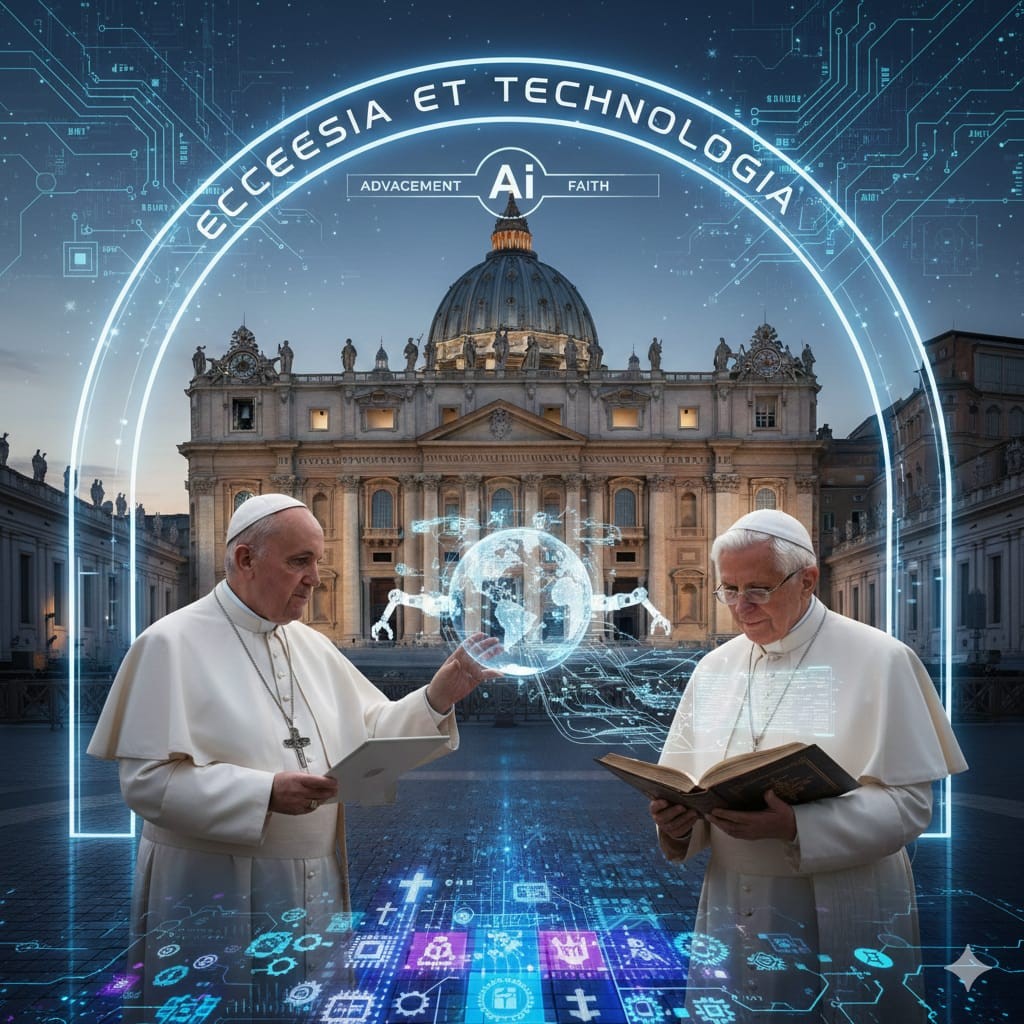
Today, we stand at a new frontier: Artificial Intelligence. Rather than retreating in fear, the Church steps forward with a “techno-progressive” spirit, recognizing AI as the latest chapter in our sacred, ancient duty to steward creation. This is not a blind embrace, but a continuation of a tradition of discernment - an active effort to harness the common good while remaining vigilant against potential harm.
As machines grow in power, the Church issues a provocative call for “Algor-ethics”. This is an ethical framework rooted in prudence, ensuring that the algorithms of tomorrow never lose sight of human dignity. Ultimately, we are challenged to be more than just users; we are called to be wise stewards, ensuring these incredible capabilities are designed to serve and enhance the flourishing of every human person.
A Theological Compass for the Digital Age
This journey into the digital frontier is not guided by technical manuals alone, but by a profound theological compass. At the heart of the Church’s response is the principle of integral human development, a cornerstone of Pope Benedict XVI’s 2009 encyclical, Caritas in Veritate.
Genuine progress cannot be measured by processing power or profit margins alone; true advancement must enrich the entire person—spiritually, socially, and economically. When we decouple innovation from this holistic vision, we risk a “progress without a purpose,” where the person is eventually subordinated to the machine.
The encyclical raises a powerful warning against a purely technical understanding of human advancement. As stated in the document, “It requires new eyes and a new heart, capable of rising above a materialistic vision of human events, capable of glimpsing in development the ‘beyond’ that technology cannot give” (CV 77). When society pursues innovation without a corresponding ethical and spiritual foundation, it risks becoming a “soulless society,” where the value of a person is subordinated to the efficiency of a machine. This perspective challenges the common assumption that what is technologically possible is automatically desirable.
Directing AI for Humanity
Pope Benedict XVI warns that progress, when separated from moral truth, becomes an “empty shell.” His encyclical emphasizes that “Without truth, charity degenerates into sentimentality. Love becomes an empty shell, to be filled in an arbitrary way” (CV 3). For AI, this serves as a powerful reminder that even the most advanced and well-meaning technologies can be directionless if they are not guided by a clear vision of what is truly good for humanity. Without an internal moral compass, AI’s potential could be exploited for goals that are merely profitable or convenient, resulting in outcomes that are ultimately dehumanising.
Integral human development calls for a different, more discerning path. It compels us to ensure that AI and all forms of technology are developed and used for goals that truly serve humanity. This requires shifting our focus from the question of what AI can do. to a more profound question: what AI should do? For example, instead of using AI solely to maximise corporate profits, it could be directed to address critical issues like poverty, access to education, and enhance healthcare access, always with the human person at the heart of its purpose. Caritas in Veritate emphasizes the need for this kind of action, stating: “This can be done by investing in rural infrastructures, irrigation systems, transport, organization of markets, and in the development and dissemination of agricultural technology that can make the best use of the human, natural and socio-economic resources that are more readily available at the local level, while guaranteeing their sustainability over the long term as well.” (CV 14)
Vision for Integral Ecology
Pope Francis’s encyclical Laudato si’ expands upon previous Catholic social teachings by introducing the concept of “Integral Ecology.” It presents a powerful framework for understanding the interconnectedness of all life and offers a profound critique of the prevailing “technocratic paradigm.” In the encyclical, he highlights that “Technology, which, linked to business interests, is presented as the only way of solving these problems, in fact proves incapable of seeing the mysterious network of relations between things and so sometimes solves one problem only to create others” (LS 20). This paradigm, which reduces reality to an object for endless manipulation, is a significant ethical danger in the development of artificial intelligence.
He argues that a true solution to our global crises cannot be found in isolated approaches. Instead, he proposes “Integral Ecology,” a concept that recognizes the deep and essential links between environmental destruction, social injustice, and our human relationships. The encyclical posits that our treatment of nature is a reflection of how we treat one another. It warns that “The basic problem goes even deeper: it is the way that humanity has taken up technology and its development according to an undifferentiated and one-dimensional paradigm. This paradigm exalts the concept of a subject who, using logical and rational procedures, progressively approaches and gains control over an external object.” (LS 106). We need to remember that the development of AI should not be viewed solely as a technical or economic matter but as an integral part of the complex web of human and natural relationships.
Re-evaluating Our Relationships
The core danger Pope Francis identifies is the “technocratic paradigm,” a mindset that believes every problem can be solved with technology and that human ingenuity holds ultimate control over reality. The encyclical emphasizes this, noting that, “Life gradually becomes a surrender to situations conditioned by technology, itself viewed as the principal key to the meaning of existence. In the concrete situation confronting us, there are a number of symptoms which point to what is wrong, such as environmental degradation, anxiety, a loss of the purpose of life and of community living. Once more, we see that “realities are more important than ideas” (LS 110).
This view treats the world as a limitless resource for consumption and reduces human beings to consumers and data points. In the context of AI, this perspective is particularly perilous. To counter the dangers of this paradigm, Laudato si' calls for a fundamental re-evaluation of our relationship with both creation and each other. The encyclical warns that a purely technological worldview can lead to a profound sense of isolation and a loss of meaning. It indicates that “For this reason, we should be concerned that, alongside the exciting possibilities offered by these media, a deep and melancholic dissatisfaction with interpersonal relations, or a harmful sense of isolation, can also arise.” (LS 47). This re-evaluation is crucial for AI, ensuring that its development is guided by a moral compass that seeks to strengthen human relationships and enhance connectedness. Algorithms and virtual connections can’t replace direct human relationships. Instead, technology should be used to support and strengthen the bonds that connect us and the world around us.
A New Way of Leadership
These teachings are directly applied to AI in documents such as the Pontifical Academy for Life’s “The Rome Call for AI Ethics” (2020) and the joint publication from the Dicastery for the Doctrine of the Faith and the Dicastery for Culture and Education, “Antiqua et Nova” (2025). The Rome Call outlines six principles for “algor-ethics”: transparency, inclusion, responsibility, impartiality, reliability, and security and privacy. It mandates that “AI-based technology must never be used to exploit people in any way, especially those who are most vulnerable; instead, it must be used to help people develop their abilities... and to support the planet” (Pontifical Academy for Life, 2020). By emphasizing that technology must serve every person while respecting human dignity, the Church advocates for a strategy that is both pastoral and prophetic. Ultimately, this represents a call for a new form of leadership capable of guiding the faithful through the complexities of a digital world.
Antiqua et Nova offers a more in-depth philosophical and theological distinction between human and artificial intelligence. “However, even as AI processes and simulates certain expressions of intelligence, it remains fundamentally confined to a logical-mathematical framework, which imposes inherent limitations. Human intelligence, in contrast, develops organically throughout the person’s physical and psychological growth, shaped by a myriad of lived experiences in the flesh” (AN 31). Building on this distinction, the document asserts that human intelligence is embodied, relational, and transcends the material world through the soul. AI, by contrast, operates on a purely functional level, imitating but not possessing the capacity for moral discernment, personal growth, or authentic relationships. The document warns against the temptation to turn to AI for meaning or fulfilment, which can only be found in communion with God.
Strategy for Future Leadership
Religious leaders must continue to move forward to understand the nuances of AI and cultivate a “wisdom of the heart” that prioritizes human dignity. This means helping people to discern the difference between a machine's algorithmic output and true spiritual guidance. Leaders should emphasize that faith is rooted in embodied, relational experiences such as communal worship, personal encounters, and acts of justice that no algorithm can replicate. This also involves guiding the faithful to not become overly reliant on AI for decision-making, as this can erode human freedom and moral responsibility.
The Church cannot address the ethical challenges of AI in isolation. A future strategy must involve active collaboration among religious leaders, ethicists, computer scientists, and policymakers. This interdisciplinary dialogue is crucial for shaping a shared framework for AI development that serves the common good. The Church can be a bridge-builder, bringing different sectors together to ensure that technology is developed with a human-centric focus and an awareness of its societal impact, especially on the poor and marginalized.
Prioritizing Digital Literacy for Pastoral Care
In a world increasingly shaped by AI, digital literacy is a vital skill for clergy and religious leaders. This goes beyond knowing how to use social media; it requires a deep understanding of the ethical, social, and psychological effects of AI on the faithful. A future strategy should integrate digital literacy into religious formation and ongoing education. Leaders must be equipped to guide their communities on issues like online addiction, the commodification of human data, and the risk of virtual spaces replacing authentic human connection.
The Church's future strategy must focus on preserving the sacredness of human relationships and communal life. While AI-driven virtual spaces can be a tool for connection, leaders must ensure they do not undermine the importance of physical presence and embodied faith. A forward-thinking plan would involve creating space, both digital and physical, that fosters genuine human connection and community building. By embracing this new way of leadership, the Church can not only guide its members but also offer a vital voice of moral reason in the global conversation about the future of technology, ensuring that AI becomes a force for good in the service of the human family and our common home.