JPIC Mission and the Church of the Poor
Vincent Anesthasiar, CMF
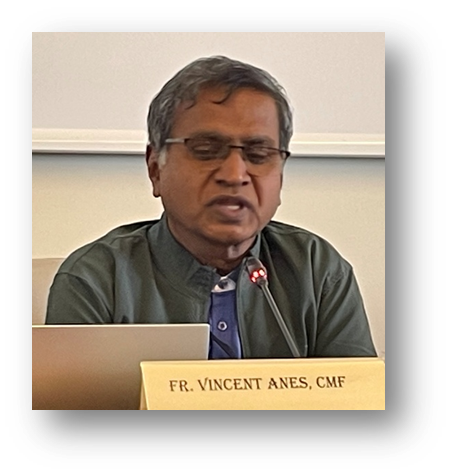
I began my service in the JPIC Commission of USG-UISG on 21.02.2026, coming from Claret Ashram, Sahari, in West Bengal, India. Claret Ashram has been serving the non-Christian Santal people since 1992 in forest region. It has supported the people through the promotion of education, income-generating activities, Santal culture and language, protection of land, forest and water, and healthcare through allopathic and natural medicines. Yet, no one has been baptized till today. But around 40 people gather on Sundays for prayer and Mass; they call themselves followers of Jesus.
The Faith Expressions of the Followers of Jesus:
On 21.09.2024, Annurima Murmu, a five-year-old non-Christian Santal girl (daughter of Guru Charan Murmu and Raimoni Murmu), while speaking with people who had come to Claret Ashram for treatment, spontaneously said, pointing to the rosary she was wearing: “I have Jesus with me; I am not afraid; nothing can harm me.†People were surprised by her testimony. That same evening, our community went to the village festival at Belpahari town. In a shop, rosaries were displayed for sale. When we asked the vendor who would buy them, since there were no Catholics in the area, he replied, “The devils are afraid only of Jesus, so many people buy and wear them.†This faith may be due to the presence of missionaries in the Sahari region.
On 25.10.2025, a young woman named Mangoli Murmu, also known as Salma (aged 22), was found on the Claret Ashram campus early in the morning, wearing a T-shirt and half trousers. When asked, she said she had come to teach children at the tuition center. Later we discovered that she was mentally ill. After tracing her parents in a neighboring village, we learned that she was married, had a child, had been abandoned by her husband, and was kept locked in a room in her father’s house. Further inquiry revealed that many mentally ill people in the villages were left untreated and wandering. We arranged medical assistance for the mentally ill and, together with the people, started a program called Alour Disha (Light to the Path), which provides food, medicine, and basic necessities for mentally ill persons both on the streets and confined at home. Today, Salma is healed and reunited with her husband. She says she wants to follow Jesus and affirms that no one loved her before, but Christians did.
On 17.01.2026, Mr. Panchano Singh, aged 80, who had been suffering from orthopedic problems, came for treatment. Initially, he could hardly walk. After two treatments, he said, “If a person is not healed in Claret Ashram, he cannot be healed anywhere in the world. The therapist touches the feet, but healing is felt in the shoulder. Miracles take place in the Ashram.â€
This lived experience of accompaniment, healing and silent witness among the Santal people reflects what Dilexit Nos teaches: “In his love, Jesus seeks us and desires that we love one another as he has loved us†(no. 216). It is through such concrete love — shown in care for the sick, the abandoned and the poor—that people begin to recognize the Church as truly the Church of the poor.
The Journey of Becoming a Servant among the Poor:
During the years of my initial formation, there was more appreciation and less correction and confrontation. Formation was like a boat sailing cutting across the waves. After initial formation, there was a deeper reflection on my mission as a religious; it was a time of inner turmoil; I felt myself like a boat anchored in the sea and tossed by waves. As part of discernment, I made a one-month retreat at the Jesuit novitiate in Kolkata, India.
This retreat helped me discern three motives of life and three apostolates:
Three motives:
1. To walk daily the road from Jerusalem to Emmaus (Luke 24:13–35) to become apostle by recognizing Jesus in contexts of marginalization, poverty, and human rights violations.
2. To walk daily the road from Jerusalem to Jericho (Good Samaritan Luke 10:25–37) to develop the capacity for compassionate action.
3. To walk daily the road from Jerusalem to Damascus (Conversion of Paul Acts 9:4–9) to remain open to personal conversion and to become attentive to God’s voice and to voices of Ananias figures of today, in order to work in net-work and solidarity.
Three Apostolates:
• To pray like Jesus
• To heal like Jesus
• To love the poor like Jesus
Since my priestly ordination on 07.04.1988, God has guided me to pray, to heal and to love the poor.
To Pray like Jesus:
“Without the silent sanctuary of the heart, the pursuit of justice risks becoming a mirror of the very pride it seeks to overcome†(Dilexi Te no.84).
Prayer is the experience of God, the cosmos and all forms of life within oneself, and of oneself being present in others and in God. This experience impels us to love God and others, because loving others is loving oneself. This contemplative experience is mandatory for engaging in works of transformation. Without contemplation, efforts to promote justice can become reactive, ego-driven and even harmful. Contemplation transforms the human person from ego to solidarity, enabling love, nonviolence and forgiveness. As Martin Luther King Jr. reminds us, before witnessing for justice, we must be able to love and respect those with whom we disagree. This inner transformation is essential for authentic works of liberation.
In the life of Jesus Christ, we see a rhythm: he prayed at night, formed community in the morning, and served people during the day along with disciples (Cf. Luke 6:12–19). This rhythm — prayer by night, community by morning and mission by noon — becomes a model for transformative living.
To heal like Jesus, I learned and practiced Lectio Divina, Vipassana, Zen, Reiki, Simplified Kundalini Yoga (SKY, and Osho dynamic meditation. I am convinced that one should meditate at least one hour daily personally; one who cannot sit in meditation for an hour should not engage in works of liberation.
To love the Poor like Jesus:
“To love the poor as Jesus loved them is to move beyond mere sentiment to a radical presence that sees, discerns, and acts†(Dilexi Te 112).
Eradication of Infanticide – Claretian Mercy Home:
My first appointment as a priest was in Tamil Nadu, India, where female infanticide was practiced, especially when the first child was a girl. Due to cultural, social and economic reasons, killing a girl child was not considered a crime and went unreported. To address this, a project called Claretian Mercy Home was started on 28.12.1987(Feast of Holy innocents) with the slogan “Girl Child is a Gold Child.†However, the first child we received was a boy born out of wedlock. This made us to see that only female children needed protection and also the infants in general.
Recognizing that this social evil could not be addressed alone by the Claretians, we formed networks with civil society organizations, initiating movements like the Forum Against Female Infanticide (FAFI) and Services, Health, Education (SHE). Through programs of awareness creation, economic incentives, nutrition and education, female infanticide has now been reduced by about 99%. Now the home continues to care for abandoned children.
From this experience, we learned the process for social projects- to study the reality, to discern the call to respond, to implement the project collaboratively and to evaluate them both during (formative) and after (summative). This aligns with the Church’s See–Judge–Act methodology.
This experience led us to engage in other missions: opposing nuclear plant projects in Tamil Nadu, working with LGBTQIA+ communities and empowering tribal communities such as the Irulars and Santals.
We also worked for the promotion of artisanal fishers by forming federations. This inspired me further academic study: an M.Phil. on artisanal fishers and a Ph.D. on conflict transformation in fishing. We now collaborate globally through the “Faith for Ocean†coalition, promoting sustainable fishing, opposing deep-sea mining, and critically engaging with the Biodiversity Beyond National Jurisdiction (BBNJ) treaty which is implemented from January 2026.
To Heal like Jesus:
“Our care for the sick must transcend the mere repair of biological functions, embracing instead the wisdom of holistic paths and the restorative power of community†(Dilexi Te no. 148).
In a context where allopathic medicine dominates, I sought to learn and promote community-based healing systems, which are holistic, preventive, and have fewer side effects. I got trained in community medicine at St. John’s Medical College, Bangalore in 1987 and later learned Acupressure, Pranic healing, Reflexology, Reiki, Varma, Naturopathy, Herbal medicine, Homeopathy and Yoga.
Institutions such as Manasu in Chennai from December 2, 2011 and Alour Dish in Sahari from October 24,2025 serve the mentally ill persons through holistic care and community support.
Learnings from These Experiences:
Experiences on the JPIC apostolates show that some missionaries promote with dedication, prayer, collaboration and solidarity, while others fall into individualism, ideological extremes, conflict and weak spiritual grounding. These contrasting realities invite the congregations to pay attention to the service of formation and apostolates:
To form missionaries as Good Samaritans, attentive to the cry of the poor and the earth;
To foster contemplative spirituality, including at least one hour of daily meditation.
To foster natural ways of living healthy to cure for oneself and others as Jesus did.
To read the Scripture with JIC lense as the foundation of prophetic mission.
To study Catholic Social Teaching from Rerum Novarum to Dilexit Te.
To learn the JPIC vision from the Founder/Foundress, charism and tradition of each congregation.
To gain knowledge of the United Nations system and international human rights instruments.
To develop socio-political awareness and interreligious openness.
To encourage ecological and sustainable lifestyles.
To build skills for collaborative mission (Doing with others).
Thanks.