His Eminence Cardinal Luis Antonio Tagle
Missionary Institutes and Synodality Charism, Prophesy and Witness
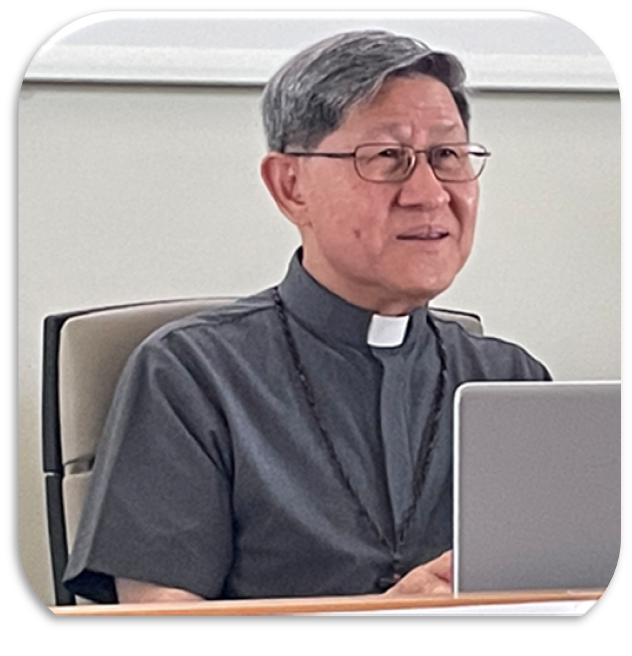
Good evening, everyone. I would like to thank Sr. Mary for this kind invitation. Now Fr. Alain Mayama, CSSp, has introduced me. I thought you would not end your introduction, but it’s good to be with all of you. I believe that on one or two occasions in the past, I have sometimes encountered SEDOS, and it is good to be with you. When I came, I asked Sr. Mary Barron, OLA “What am I doing here?” Since she is an expert on the theme of Missionary Institutes and Synodality, Charism, Prophecy and witness. Well, I guess I have to obey our dear Mother, in the spirit of synodality. I won’t pretend to be an expert on this wonderful theme, and since these days will be devoted to an experience of synodality, I think my contribution is just to stir your hearts and imagination for further prayer, discernment, and sharing.
I shall divide my sharing into two major parts: first, a reflection on synodality, and second, a reflection on re-imagining or re-envisioning mission. All of us are called to be missionary disciples; but in a particular, unique, and radical way, Missionary Institutes are called to witness to us what mission in discipleship is all about.
Reflection on Synodality: Pope Francis, calls the Church to discern a path forward as a community of faith — to become a Synodal Church that reaches out to the world, especially to those who are outcast or rejected. A Church that fully proclaims the infinite, unconditional, and universal mercy of God. I quote that from Pope Francis. It’s a concise quotation: “A Synodal Church is a community of faith that reaches out to the world, especially to the outcast and rejected, and is a Church of hope, bringing the infinite, unconditional, and universal mercy of God.”
For this Part on Synodality, I want to share three simple points:
1. A Synodal Church is often depicted as a church where we, as missionary disciples, walk together. The word “synod” comes from the Greek word “synodos,” meaning “walking together.” It’s about taking the same path together. It may seem simple to walk with others, but in reality, we know how it’s easily said but not always easy to do. In community life — whether in your institutes, our dioceses, or in our personal experience — I have heard many say, “Your Excellency, my mission will be more successful if I walk alone. Please remove my companions; they are obstacles to my mission.” I hope you’re not laughing because this does not happen in your institutes — but really, we do walk together. So, my question is: how can I walk with others?
There are many proposals from experts, spiritual writers, and your own experience that you will listen to over the coming days. For this sharing, I am inspired to go back to the prophet Micah. His words in Micah 6:1-8 are quite significant. The setting is like a court where God puts Israel on trial. The case against Israel is presented — their infidelity and forgetfulness led them to walk alone, refusing to walk with others. Instead of apologizing, Israel, instead of accepting the charge, tried to bribe God — bribery is not new; it’s an old strategy. They offered holocausts, calves, thousands of rams, streams of oil, even their firstborn sons to appease God. But God, full of tenderness, responds: “What is expected of you is to do justice, love, goodness, and walk humbly with your God.”
I believe, then, that synodality is only possible if we walk humbly with God. I see two possible interpretations of “walking humbly.” First, if my co-sojourner is God Almighty, I better walk humbly. If I am walking beside or with a superior, I should behave humbly. But I prefer the second interpretation: to walk humbly with God means to walk the way God walks. God’s walk-in salvation history is humble. The mighty, omniscient, all-powerful God chooses to walk humbly — with the family of Noah, Abraham and Sarah, the enslaved people of Israel, Boaz and Ruth, King David, Zechariah and Elizabeth, Mary, Joseph. God’s co-workers are not always the greatest or the most powerful according to the world’s standards. This humble walk of God includes Jesus, who, in his self-emptying kenosis (Philippians 2), calls simple fishermen, shares secrets with them, and walks humbly. The communion among the Three Persons of the Holy Trinity — a dance of love and unity — also reflects this walking together.
Jesus himself said, “No one comes to the Father except through me,” (Jn 14: 6) and he is an example of humility, saying, “I can do nothing on my own authority…because I seek not my own will but the will of the Father” (Jn 5:30). The Holy Spirit, too, teaches and reminds us of what Jesus has said. The Spirit does not create a fan club but receives what Jesus receives from the Father. The eternal, omnipotent God is humble. We often imagine the Incarnation as the Son shedding his prerogatives to become human, but we forget how often we, as humans, rush to rise and become omnipotent, failing to walk humbly with God. This humility is the path to true synodality.
2. God walks with people and communities endowed with freedom. Despite all God has done for Israel, Israel remains free to walk with God or not, to walk together or not. In John 6, after Jesus’ discourse on the bread of life, many who found his teaching too hard, left him. Jesus turned to the Twelve and asked, “Do you want to leave too?” This highlights the human dimension of freedom. Some say, it would be better if humans did not have free will, but that is not true. Without freedom, we would be like objects being dragged. I remember interviewing a couple before marriage. I asked the bride if she was entering this life of commitment freely, and she replied, “But what can I do? He’s the only one who showed interest in me.” Without the expression of freedom, walking together is impossible.
In ordination and religious life, freedom is also essential. Synodality respects human freedom and calls us to recognize, with humility and sometimes with pain, the lack of freedom or the enslavement within us. Synodality is a call for purification — to free ourselves from restrictions that hinder love, respect, and cooperation. With Jesus and the Spirit as our guides, we are invited to open ourselves to ongoing purification, so that we can see more clearly, walk more freely, love more authentically, and serve more sincerely.
3. We walk humbly with people gifted with freedom, and this walk will always be humble because we recognize our limitations. It is respectful because we honour their freedom, and it is also humble because we understand the cultural and personal differences that shape each person. Sister Mary spoke about interculturality; as a church and missionary institute, we carry cultures with us. To walk together across cultures requires what is called cultural intelligence — understanding how our culture shapes us, learning about others, and becoming bridges of encounter. Every culture embodies a worldview and values, which must be faced, admitted, and purified. Learning from anthropology and sociology, and through simple observations, we can develop cultural intelligence. For example, how the use of space in a church reflects cultural values; the arrangement of seats, the distance between the one presiding and the congregation, or the way people greet each other.
Jesus himself was deeply rooted in his culture but also brought the culture of God. He allowed the leper to approach, a woman to touch his feet, creating new concepts of space and inclusion. He included outsiders like the Canaanite woman and the Roman centurion. The Church, too, must learn to walk with diverse cultures, respecting their differences and seeking unity through walking and dialogue.
Now, I shall reflect briefly on re-imagining mission. I am convinced that the Church’s mission makes the Church, and that a renewed mission renews the Church. It’s a dynamic relationship. I invite you to re-imagine mission in the spirit of synodality — walking together, respecting freedom, and embracing diversity. The first image I shall propose is the door of a house:
The door unites the outside and inside — it distinguishes, yet it also connects. A renewed Missionary Church takes its door seriously. Through the door, grace, worship, and service flow into the world, and the mystery of the Holy Spirit’s presence is brought into the church. The Church is both outgoing and welcoming. The door can be anywhere — in a home, a community, a taxi. For example, I heard of a woman in Lebanon who worked with detained migrants. She once went to Syria for a conference, and the taxi driver refused to accept payment, because he recognized her from the time she had helped him when he was imprisoned as an illegal migrant. That act of kindness and recognition is a powerful form of mission.
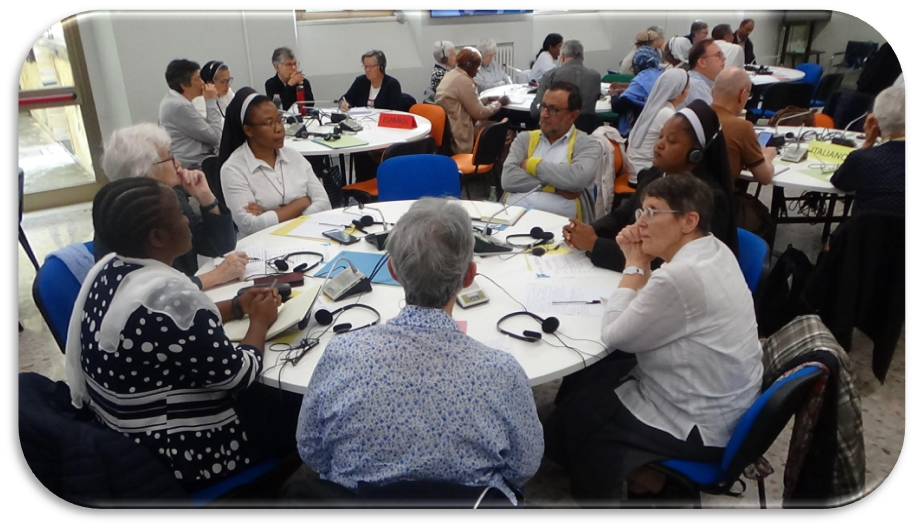
Another image is the table:
As an Asian, I love food. Sharing a meal is about coming together as a community, as a family. A renewed church is like a big table with room for everyone — especially the poor — where good things are shared, dignity is preserved, and mutual acceptance and participation flourish. The table challenges greed, indifference, and discrimination. Economy often promotes death rather than life, but the Church should be a sign of a different order — a table of fellowship and inclusion.
The third image is music — songs of lament and joy:
Music runs in the blood of many cultures, especially in Asia. It is a powerful means to convey messages, touch hearts, and foster fellowship. Songs of lament express our suffering and cry out to God; songs of joy celebrate human goodness and praise. A missionary church sings and dances to the rhythm of hope and lament, especially in the context of the people’s deep hopes and suffering.
Finally, I want to share a story from a summer camp I once held for young people. I asked the youth to reflect on their purpose in life. After my talk, a young girl asked me, “Bishop, would you sing for us?” I told her to ask meaningful questions about the theme first. Many questions came, but one young boy finally asked, “So, Bishop, will you sing for us now?” I invited everyone to sing a popular song together. Afterwards, the children rushed to ask for blessings, autographs, or selfies. I wondered: what do they see in me? Am I seen as a bishop, a singer, or something else? I’ve always tried to behave humbly, and Pope Francis always advised me to do so when I travelled abroad.
A year later, at a similar camp, a boy approached me and said, “Last year you signed my T-shirt.” I asked, “Oh, so you’re one of them now?” He replied, “Since then, I haven’t washed my Shirt — not for a year.” I was surprised. He explained, “I fold it every night and place it under my pillow. I don’t see my father anymore, but with this T-shirt, I feel I have a family in the Church and a father in you.” That moment was a profound example of how a church can touch lives in unexpected ways — through the power of kindness, recognition, and simple gestures.
This, I believe, is a genuine face of a renewed church and mission. Thank you for your patience.