Archbishop Fortunatus Nwachukwu
From Ad Gentes to Inter Gentes Celebrating the 60th Anniversary of “Ad Gentes”
(On the Activity of the Church)
A. Introduction
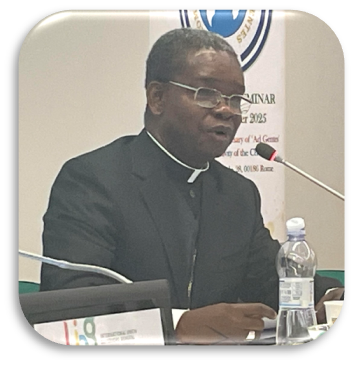
I am deeply honoured to address this distinguished gathering on the occasion of the SEDOS Autumn Seminar. I thank the leadership of SEDOS for the kind invitation and for your enduring service to the Church’s mission worldwide. Your dedication to service, study, and dialogue keeps alive the missionary spirit that is at the heart of the Gospel. In an age marked by a fading sense of history and an eagerness to modernise everything, SEDOS stands as a remarkable witness to the enduring wisdom of tradition and the creative vitality of faith. I commend you for your tireless work in documenting global mission and renewal among institutes of Consecrated Life, and for creating spaces where the Gospel’s transformative power is encountered, shared, and lived in every context.
Our reflection today shall proceed in three dimensions, each exploring the missionary vocation of the Church and its living faith. First, we remember the past in the spirit of Ad Gentes, returning to the heart of the kerygma and to the first mission that began with Jesus, who preached the Kingdom, and with Saint Paul, who brought the Gospel to the nations. Second, we will reinterpret the meaning of mission today through the lens of synodality, exploring how the Church is called to “journey together” (syn-hodos): “to go forth” (ex-hodos), and to work, walk, run and remain together, in a world that hungers for communion and hope. Third, we shall reimagine the Church for the future as the New Tribe or Caste, gathered from many peoples, bound by baptism and communion, and symbolised in the image of the Church of the Sheaves.
B. Remembering the Past: The Spirit of Ad Gentes
Sixty years after the promulgation of Ad Gentes, the Church is invited once more to pause, to listen, and to rediscover the pulsating heart of her missionary identity. The Decree on the Missionary Activity of the Church was one of the most luminous achievements of the Second Vatican Council (1962-1965). The Council Fathers began from the conviction that mission is not a programme added to the Church, but her very essence. In other words, the Church does not have a mission; she is mission, the living continuation of the sending of the Son and the Spirit. As Ad Gentes declares, “The pilgrim Church is missionary by her very nature, since it is from the mission of the Son and the mission of the Holy Spirit that she derives her origin, in accordance with the decree of God the Father” (2). To speak of mission, therefore, is to speak of the Trinity; to speak of evangelisation is to speak of God who gives Himself in love (Jn 3:16; 20:21).
Jesus, the Proto-missionary, began and concluded his public ministry by charging his disciples to share in this same mission. He said to them, “As the Father has sent me, even so I am sending you” (Jn 20:21). At the beginning he called fishermen to become “fishers of men.” Fishers, unlike fish-farmers, venture into deep and uncertain waters; they go to rivers and seas to catch fish, drawing them out of the anonymity of those habitats and giving them a new belonging in the boat of the fishers. Similarly, the disciples were to go into world and draw men from the anonymity of the world and introduce (“baptise”!) them through Christ to the Blessed Trinity. This is the precisely the meaning of the post-resurrection mandate: “Go therefore and make disciples of all nations, baptizing them in the name of the Father and of the Son and of the Holy Spirit” (Mt 28:19).
Mission, then, is not recruitment but relationship; not expansion but invitation into divine intimacy.
The Decree Ad Gentes marked a decisive turning point in the Church’s self-understanding. It broke the boundaries of a colonial mindset and redefined mission as participation in the Missio Dei — God’s saving plan for humanity. Pope Paul VI, in continuity with the Council, affirmed in Evangelii Nuntiandi that “the [Church] exists in order to evangelise” not through imposition but through “the witness of fidelity to the Lord Jesus” (§14, §41). This entails a shift from expansion to participation, and it represented more than a pastoral reform; it was a theological reawakening. The Church does not merely send missionaries; she is herself the missionary, the sacrament of God’s outreach to the world (Mt 28:19–20; Acts 1:8).
To remember Ad Gentes is also to recall the spirit of the earliest missions, when faith went forth from the familiar hills of Jerusalem to the distant lands of the nations. At the centre was the kerygma itself, the bold and life-giving proclamation that Jesus Christ, the crucified and risen, is Lord (Rom 10:9; Acts 2:36). From this message the first evangelisation drew its power, and from it the Church continues to draw the strength of her mission. It was this saving message that compelled the apostles to go ad gentes, “to the nations,” carrying the Gospel beyond Israel. Peter preached to the Gentiles, Thomas reached India, Andrew proclaimed the faith in Greece, John evangelised in Asia Minor, and, according to tradition, Matthew in Ethiopia, thus fulfilling the Lord’s command that “repentance and forgiveness of sins should be preached in his name to all nations” (Lk 24:47).
Saint Paul stands as the defining figure of the early Christian mission, carrying the Gospel to the Gentile world with tireless zeal: “I make it my ambition to proclaim the Gospel, not where Christ has already been named” (Rom 15:20). His journeys took the message of salvation from Antioch to Corinth, from Ephesus to Rome.
The successors of these earliest missionaries would take the same Gospel into the cultural centres of Europe, Asia, and North Africa. There the Gospel faced the cruelty and power of the Roman Empire, enduring persecution (Acts 14:22; 2 Cor 11:24–28) yet producing fruit in abundance (Mk 4:20).
This understanding of mission was deepened by subsequent Popes. Saint Paul VI taught that “the first means of evangelisation is the witness of an authentically Christian life” (Evangelii Nuntiandi, 41). Saint John Paul II, in Redemptoris Missio, described the missionary spirit as “the real measure of self-giving to one’s brothers and sisters” (§79) and reminded the Church that “faith is strengthened when it is given to others” (§2). Pope Benedict XVI affirmed that Ad Gentes is “not directed only to non-Christian peoples or distant lands, but above all to every social and cultural setting, and to every human heart” (Address for the 40th Anniversary of Ad Gentes, 2006). Pope Francis, in Evangelii Gaudium, insists that “missionary outreach is paradigmatic for all the Church’s activity” (§15). In fact, in reorganizing the Roman Curia, with the Apostolic Constitution, Praedicate Evangelium, he placed the Dicastery for Evangelisation as the first of the Dicasteries, in line with his teaching that mission precedes doctrine.
Across these decades, one conviction endures: The Church cannot be herself unless she goes forth. In his video message for World Mission Day 2025, Pope Leo XIV calls the faithful to be “missionaries of hope among the peoples” and to commit themselves anew to “the sweet and joyful task of bringing Christ Jesus, our Hope, to the ends of the earth” (Pope Leo XIV, Video Message for World Mission Day, 2025).
From the first missionary Church of the earliest disciples of Jesus and their immediate successors, other churches were born. Communities took root in different lands, nourished by the Word, the Eucharist, and the service of charity (Acts 2:42–47). The Decree recalls that “the proper purpose of missionary activity is evangelisation and the planting of the Church” (Ad Gentes, 6). This task remains vital today, for the Church still carries the responsibility of reaching those who have not yet heard the name of Christ. Her mission continues to invite all peoples into communion with God and with one another, for “what has not been assumed by Christ is not redeemed” (Ad Gentes, 3). The call to conversion and faith remains at the heart of the Church’s life.
In the course of time, the Church has matured in many regions of the world where the first evangelisation once took place. The seed planted by the apostles has grown into a global community of faith. In this new moment of history, the Church begins to see that the mission entrusted to her is not only outward but also inward. There is the continuing mission ad gentes, to those who do not yet know the Gospel, and there is also a mission ad intra, within the Church herself, where renewal and evangelisation must take root again (Rev 2:4–5). From this awareness arises the vision of mission Inter Gentes, a mission that unfolds among peoples and cultures, drawing strength from mutual exchange and shared faith.
Significantly, Ad Gentes placed before the Church the enduring prospect of inculturation and communion. The Gospel must be planted in every culture so that each people may encounter Christ in its own language, culture, music, and symbols. Saint John Paul II urged that the Church “make itself all things to all people,” engaging contemporary cultures with sympathy and perseverance so that the Gospel may transform them from within and awaken them to faith, hope, and charity (Pontifical Council for Culture, 1983). As the International Theological Commission later affirmed, “in the Body of Christ, cultures, insofar as they are renewed by grace and faith, are complementary” (Faith and Culture, 1988, §21). This task requires collaboration, collegiality, and deep respect for others — an intuition that anticipated today’s call to synodality.
In sum, the Church remembers Ad Gentes not to admire a past achievement but to rekindle a present vocation: to go forth inter gentes, among the peoples, in friendship, humility, and hope.
C. Reinterpreting Ad Gentes Today: Inter Gentes and Synodality
The Church today is called to live her missionary identity in a renewed way: not ad gentes only, but inter gentes — not only toward the nations, but among and between the peoples. The spirit of Ad Gentes remains the seed; inter gentes is its flowering in a world that still thirsts for the light of Christ. Mission inter gentes reflects the maturity of a Church that is at once local and universal, rooted and open, listening and proclaiming. The Church lives this call best when she acts not as an institution looking down from above but as a companion walking besides, learning from those she serves, and witnessing through closeness.
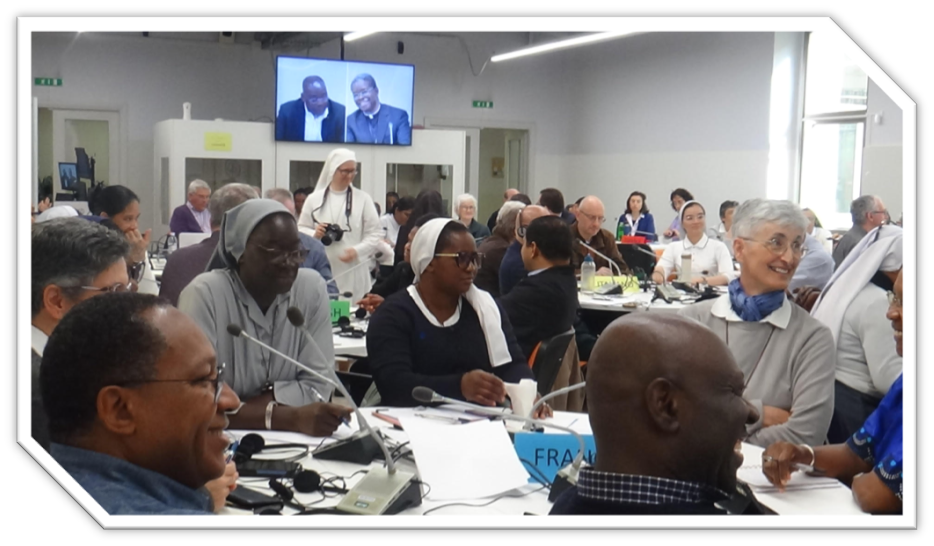
At the heart of this missionary renewal is synodality, the grace of “journeying together.” The term itself, from Greek syn(“together”) and hodos (“way”), defines what the Church is before describing what she does. The Church is not simply a community that gathers; she is a people on the way. The Vademecum for the Synod on Synodality, published by the Synod of Bishops in 2021, describes synodality as “walking together, listening to one another, participating in mission, and engaging in dialogue” (§10).
Pope Francis has repeatedly emphasised that the Synod is not “a convention, a parliament, or a senate where people make deals and reach a consensus,” but “an ecclesial expression… a protected space in which the Church experiences the action of the Holy Spirit” (Opening Speech, Synod on the Family, 5 October 2015). In another address, he warned that “many leave the kerygma, invent synods and counter-synods … which in reality are not synods … because to be a synod … the Holy Spirit is needed; and the Holy Spirit kicks the table, throws it and starts over” (Address to the Diocese of Rome Pastoral Conference, 9 May 2019). For Pope Francis, “the Synod is an ecclesial exercise in discernment. To speak frankly and listen openly are fundamental … discernment is not an advertising slogan … but an interior attitude rooted in an act of faith” (Opening of the Synod of Bishops on Young People, the Faith and Vocational Discernment, 3 October 2018).
C.1 The Exodus and the Synodal Journey
Every syn-hodos presupposes an ex-hodos — a going forth, a way out. The Church, like the people of God in the Hebrew Scriptures, is primarily an Exodus community and therefore a synodal one. She has been led out of the bondage of sin and eternal death through the passion and resurrection of Christ, as Israel was led out of slavery in Egypt through Moses. Yet she cannot walk together or advance in her mission when she becomes closed within herself, self-sufficient in spirit, caught in routine, or burdened by excessive bureaucracy that stifles pastoral creativity and missionary joy. The journey of faith always passes through the desert, where the heart learns trust and obedience. When the Church accepts this journey, she becomes alive and missionary. To be a synodal Church is to hear again the call of the Lord, “Arise, let us be on our way” (Mk 14:42). The Church that resists the Exodus becomes static; the Church that embraces it becomes dynamic. This is the invitation to move forward in faith, to walk as a people who listen, discern, and serve together.
C.1.1 The Temptation on the Way and the Covenant
The Exodus experience, as already mentioned, is also a desert experience, with moments of grace, but also of challenge and temptation. The Israelites were together on their way out of Egypt; they walked, ate, and conversed together. Yet the joy of their liberation did not prevent conflict. At Massa and Meribah (Exod 17:7), they quarrelled with God and tested His faithfulness. Massa derives from nâsâh, “to test,” while Meribah stems from rib, “to contend.” Yes, in the desert, the People of God faltered in the face of the extreme difficulties they encountered. They not only complained against their leaders and against God, and some of them even desired to return to their place of slavery. Yet, God did not abandon them. God gave them the Law at Mount Sinai, the Horeb moment of encounter, covenant, and identity. To the words of the Lord, the people responded, “All that the Lord has said, we shall do” (Exod 19:8).
This covenant became the foundation of their unity under God’s guidance, an Old Testament model of syn-hodos complemented by the principle of subsidiarity, which Moses learned from his father-in-law, Jethro. Yet, the Exodus experience teaches us that even liberated people, when they cease to sense God’s presence, risk turning joy into rebellion. The same applies to the Church: if she loses the awareness of God among her people, the Synodal Way may degenerate into mere human debate. She must find creative ways to address internal conflicts and resolve differences. In this regard, the model of subsidiarity proposed by Jethro offers enduring wisdom.
C.1.2 The Human and the Divine Solutions
In the wilderness, the people found both human and divine answers to their struggles. On the human side, Moses learned from his father-in-law the wisdom of shared responsibility and discernment in community (Exod 18:12–27). On the divine side, God gave the commandments, offering a clear path of life and justice (Exod 20; Deut 5). Both responses were necessary, but only the divine word could renew the heart. Before entering the promised land, Joshua called the people again to choose whom they would serve, saying, “As for me and my house, we will serve the Lord” (Josh 24:15). The renewal of the covenant was essential for their unity and mission. In the same way, the Church must continually return to the living Word. The synodal path is not only a structure of dialogue but a movement of conversion grounded in listening to God’s voice together.
C.1.3 Conversion and Renewal
Every genuine journey with God begins in conversion. It is a movement of the heart that restores the soul to its original purity and strength. When the Church opens herself to this grace, she becomes more faithful to the Gospel and more fruitful in her mission. Conversion can be compared to the renewal of an electronic device that has become slow or unresponsive. When a device malfunctions, the most effective solution is often to restore it to its factory settings, returning it to the condition in which it first left the maker’s hands. In a mobile phone, for example, this process removes corrupted data, resets the system, and makes the instrument once again efficient and reliable. In the same way, authentic conversion restores the human person to the order of grace, removing what impedes the free work of the Spirit and allowing life to function according to its divine design.
In the Hebrew Scriptures, conversion is expressed by the word shuv, meaning to turn again toward God. The prophets used it to call the people away from sin and back to the covenant path. Later rabbinic tradition spoke of teshuvah, a return not only of thought but of the whole person to right relationship with God and neighbour. By choosing the theme of synodality for the Sixteenth Ordinary General Assembly of the Synod of Bishops, Pope Francis invited the Church to rediscover this same dynamic of return — to recover her original identity as a people who journey together under the guidance of the Spirit. In his address marking the fiftieth anniversary of the Synod of Bishops on 17 October 2015, he affirmed that the Church is “nothing other than the journeying together of the flock of God along the paths of history toward the encounter with Christ.”
C. 2 The New Testament Model of Synodality
The New Testament reflects a synodal path of “togetherness”, where communion and mission grow through shared movement. I will highlight three such moments: “being together in faith and friendship with the Lord (Jn 1:39; Mk 3:14; Acts 2:42-47); walking together in discernment and trust (Lk 24:13–35; Mk 6:7), and running together in love and hope toward the risen Lord (Jn 20:1-11).
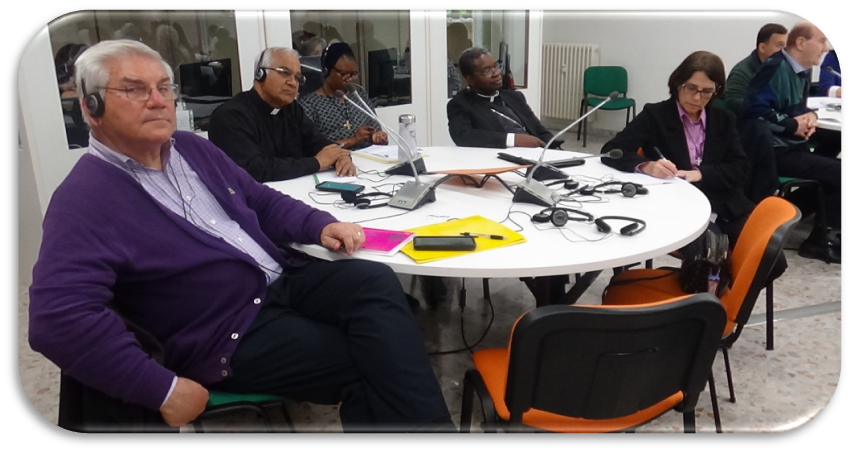
C.2.1. Being Together
Before sending His disciples on mission, Jesus first called them to be with Him (Mk 3:14). This moment of communion was the beginning of their vocation. They came and saw where He was staying, and they remained with Him that day (Jn 1:39). In His presence, they learned friendship, mercy, and trust. On the mountain, He gave them the Beatitudes as the rule and covenant of love (Mt 5:1–12), forming a community shaped not by power or privilege but by humility, compassion, and peace. This experience of being together with Jesus is where every mission begins.
Such communion is not simply preparation for mission; it is mission itself. When believers share life with the Lord and with one another, they already proclaim the Gospel. Their unity becomes a visible sign of the Kingdom, a silent yet eloquent witness that evangelises by its very existence. Vita Consecrata teaches that such unity is itself evangelising: “They are actions pleasing to our common Father, which show the will to journey together along the path of truth and love” (§101). When believers live in communion, they already proclaim the Gospel. Their life together becomes a light for the world. As the same document adds, those who give their whole life to Christ “bear witness to the grace which transfigures Christian life” (§109).
C.2.2 Walking Together
The story of the disciples on the road to Emmaus (Lk24:13–35) reveals the heart of synodality. In the evening of the day of the resurrection of Jesus, two of his disciples were on their way to the countryside locality. As they talked about Jesus and all that had happened, Jesus Himself drew near and walked with them, though they did not recognise Him. He listened to their story, talked with them, and opened the Scriptures, helping them to see how God’s plan of salvation was unfolding through suffering and resurrection.
Their journey passes through four moments: talking about Jesus, talking with Him, eating with Him, and proclaiming Him as Lord. When they talked about Him, He came close; when they talked with Him, their hearts began to burn within them (Lk 24:32). When they ate with Him, their eyes were opened, and they recognised Him in the breaking of the bread. Then, filled with joy, they went out to proclaim His name (Lk 24:35). A Church that talks about Jesus will find Him drawing near; a Church that talks with Him in prayer experiences the fire of His Spirit; a Church that eats with Him in the Eucharist sees Him clearly; and a Church that proclaims Him becomes His living witness in the world.
At Emmaus, the Eucharist becomes the centre of recognition. The opening of the eyes at the breaking of bread reverses the closing of the eyes in Eden (Gen 3:6–7). In sin, humanity turned the gaze inward, as though the mirror of the soul had become a camera fixed on itself. The human being began to take only “self-portraits,” losing sight of God and neighbour. At the table with Jesus, that inner lens was turned outward again. The image was restored to its original direction — to reflect Christ, “the image of the invisible God” (Col 1:15). In the Eucharist, the focus of the human heart is renewed; what was distorted by sin is restored to grace.
The Emmaus story thus portrays the Church inter gentes: walking with others, listening and interpreting the Word together, and recognising Christ in shared life and mission. Synodality transforms walking into worship and dialogue into revelation. It is, as the Final Document of the Synod affirms, “a path of spiritual renewal and structural reform that enables the Church to walk with every man and woman, radiating the light of Christ” (§28; Francis, XVI Ordinary General Assembly of the Synod of Bishops, 2024).
C.2.3 Running Together
On Easter morning, Peter and the beloved disciple ran to the tomb (Jn 20:3–8). Peter, symbol of the elder Church and apostolic authority, ran with steadiness and dignity. The other disciple, the younger, and symbol of the newer Churches and youthful zeal, ran with speed and joy. The younger arrived first but waited for Peter to enter. Each honoured the other’s grace, showing that in the Church, authority and vitality do not compete but complete one another.
Here we see the true synodal balance, communion between generations, between experience and creativity, between the wisdom that guards and the enthusiasm that renews. Vita Consecrata calls this “a journey towards perfect unity along the path of truth and love” (§101). Authority and charism are companions on the same road, each serving the other for the sake of mission.
There is also a third runner, often unseen, Mary Magdalene. She came before both, remained the longest, and was the first to proclaim the Resurrection. She represents the hidden Church: contemplatives, consecrated women, the poor, and all whose silent fidelity sustains the Gospel. As Saint John Paul II teaches in Mulieris Dignitatem, “Mary Magdalene was the first eyewitness of the Risen Christ, and for this reason she was also first to bear witness to him before the Apostles,” showing that “Christ entrusts divine truths to women as well as to men” (§16). Mary embodies the apostolic love that runs before understanding, the faith that proclaims before proof. She is called “Magdalene” not necessarily in reference to her place of origin, but because she was a “tower” (in Hebrew, Migdal/ah).
In this Easter race, no one is left behind. Peter (the elder Church), the Beloved Disciple (the younger Church), and Mary Magdalene (the faithful witness, the Migdalah/tower) each reveal a vital dimension of the Church. Together they form one mission inter gentes, the harmony of difference within the unity of faith. This is the Church syn hodos, a pilgrim people of communion and hope: staying, walking, talking, and running together toward the risen Lord who continues to journey among and with His own.
D. Toward Greater Collaboration: Gratitude, Openness, and Hope
The Church that lives inter gentes and journeys in synodality is a Church of gratitude, openness, and hope - three signs of a Church that truly stays and moves together. They give life to our communion and make mission inter gentes tangible in the most human way. They are not ideas or wishful thinking, but living attitudes shape how we remember, how we listen, and how we look forward together in faith.
D.1 Gratitude. When we look at the road we have travelled, gratitude comes first. It begins in the younger Churches, who remember with affection those men and women who brought them the faith. Many of them left their homes while still young. They crossed seas and continents, carrying only a Bible, a rosary, and a burning love for God. Many never returned, often because they did not wish to return or were consumed by their mission. They built schools, hospitals, and parishes in places they barely knew. They learned local languages, developed them, and shared local food. They suffered illness, loneliness, and misunderstanding. Many died quietly in the lands they came to serve, far from their families. Their graves are now part of our soil. We are their fruit. Their stories are written in our hearts. So, we thank the older Churches that brought the Gospel to many lands with courage and faith.
As Scripture says, “Remember your leaders who spoke the word of God to you. Consider the outcome of their way of life and imitate their faith” (Heb 13:7). To remember them is not only to honour the past but to renew our sense of mission. Gratitude makes us aware that faith is never owned; it is received and handed on. It keeps us humble, because we know that others walked this path before us and gave their lives so that we could believe. Gratitude turns memory into responsibility. It keeps the memory of sacrifice alive and transforms it into renewed zeal.
D.2. Openness is the second grace and the condition for every step forward. Pope Francis reminds us that he prefers a Church that “goes out” to one that is closed in on itself (Evangelii Gaudium, 49). A Church that is open is eager to meet people from other local communities, to listen, to welcome, and to work together in mutual trust. She is not afraid of strangers or new voices. She is not ashamed to ask for help or to receive it. She invites others to share in the mission, to collaborate, and to offer their gifts.
In this sense, the older Churches, rich in wisdom and experience, look upon the younger Churches with affection, seeing in them the same joy and fire that once sent their own sons and daughters into mission. Today, more than two-thirds of the world’s Catholics live in Africa, Asia, and Latin America, regions once evangelized by those very missionaries who left their homes with faith and courage. Now, from those same regions, new missionaries rise to serve in Europe, the Americas, and beyond. The Spirit continues to reverse and renew the flow of mission. The older Churches listen, bless, and learn; the younger Churches share their vitality and hope. Together they form one body, alive in mutual exchange. This is the Church that Pope Francis calls “a field hospital after battle” — a place where everyone can enter and find healing, where no one is a stranger.
Openness means trusting that grace can come from unexpected places. It is readiness to receive as well as to give. The Church that is open welcomes partnerships in mission, shares her gifts, and rejoices when others succeed. She lives Saint Paul’s invitation: “Welcome one another, as Christ has welcomed you, for the glory of God” (Rom 15:7). This openness is not abandoning tradition but sharing it. It is not loss but renewal. Like Peter, who entered the tomb after the beloved disciple, the older Churches bring depth, discernment, and stability, while rejoicing in the energy that runs ahead. True openness requires faith — faith that the same Lord who began the work will bring it to completion.
Saint Paul writes, “You who once were far off have been brought near by the blood of Christ… You are no longer strangers and aliens, but fellow citizens with the saints and members of the household of God, built on the foundation of the apostles and prophets, Christ Jesus himself being the cornerstone” (Eph 2:13, 19–20). In this sacred household, all who were once far away are now part of one family. The Church welcomes all peoples, but she stands firmly on her foundation — the faith of the apostles, the vision of the prophets, and the witness of generations who believed before us. Their prayers, their struggles, and their sacrifices are the stones on which we now build. As Isaac Newton said, “If I have seen further, it is by standing on the shoulders of giants.” So, it is with the Church. We see further because we stand on the faith of our fathers and mothers.
The present generation receives this heritage not as a possession to guard but as a gift to renew. Each generation receives the faith as a gift and must pass it on faithfully and fruitfully. The Church inter gentes, rooted in apostolic faith and built upon Christ the cornerstone, advances through history as one living temple — faithful to her origins, open to her mission, and filled with hope in the Lord who makes all things new.
D.3 Hope. When gratitude and openness meet, hope is born. Hope is the grace that allows us to see the future together. It is the sign of a Church that is learning to collaborate, not as groups working in parallel, but as one family. Hope teaches us to believe that unity is stronger than difference, that dialogue is richer than division, and that mission belongs to all.
The Church that journeys inter gentes and lives in synodality is a Church of gratitude, openness, and hope. She remembers the past with thanksgiving, welcomes the present with courage, and looks to the future with faith. She walks with the world as friend and witness, knowing that God is already on the road ahead: “The Lord your God goes with you; He will not fail you or forsake you” (Deut 31:6).
Here I want to mention the theme of “The Church of the Sheaves,” so dear to my heart. It is the image of a collaborative mission born from the sacrifices of those early missionaries who went out “in tears” carrying the seed of faith to be sown in mission lands. They left home and comfort to plant the Gospel in foreign soil, believing the Lord’s promise that “those who go out weeping, bearing the seed for sowing, shall come home with shouts of joy, carrying their sheaves with them” (Ps 126:6). Today we are those sheaves, the fruit of their labour, returning not in dependency but in partnership. Their faith became our inheritance; our mission now becomes their harvest. This moment calls us to gratitude and to responsibility—to continue their work not as recipients alone, but as mature collaborators in the same field of the Lord.
This is the mystery and beauty of the Church of the Sheaves. The “evangelised” have now been “brought home” into the one household as fellow evangelisers (Jn 4:42; Eph 2:19); those once taught now teach; those once served now serve beside their teachers as co-workers, colleagues, and members of one family. Here, the sower and the reaper rejoice together, for in God’s field, all belong to one another, and all belong to Him who gives the growth (1 Cor 3:7). Africa and Asia, once the mission field, now join and support their former evangelizers and send missionaries across the globe, carrying both memory and gratitude. It is a Church that gathers not for itself but for all, where every believer becomes both seed and harvest, both field and reaper, all rejoicing together in the Lord of the harvest (Mt 9:38).
E. Reimagining the Church: The Future as the New Tribe
From the beginning, God’s plan of salvation has been to gather His scattered children into one people. This divine purpose reaches its fulfilment in Christ, who forms in Himself a new humanity united by the Spirit. Lumen Gentium describes the Church as the “mystical Body of Christ,” in which “Christ made His brothers, called together from all nations, mystically the components of His own Body” (LG 7). The Church is therefore the new tribe of God: a people born not of blood or territory but of faith and baptism, animated by the same Spirit that gives life to Christ’s Body. It gathers men and women from every nation into one communion without erasing their differences but redeeming them in love.
The mission of this new tribe is both ad gentes and inter gentes— sent to the nations and living among them. The Church grows not through domination but through communion; not through conquest but through witness. Like yeast in the dough (Matt 13:33), it transforms the world from within by the quiet power of love and service. Its leaders must embody, as Saint Paul exhorts, “the mind of Christ Jesus… who emptied Himself, taking the form of a servant” (Philip 2:5–8). The future Church will be credible and fruitful only when it lives this humility — broad in vision, large in heart, and ready to love universally with the heart of Christ.
The roots of this new tribe can already be seen in the Old Testament. God’s promise to Abraham, “In you all the families of the earth shall be blessed” (Gen 12:3), reveals that His election was never meant to create an exclusive nation but a universal family. Ruth the Moabite expresses this same movement of faith and belonging when she declares, “Your people shall be my people, and your God my God” (Ruth 1:16). By her faith she enters the covenant community and becomes an ancestor of David and of Christ (Ruth 4:21–22). These stories prefigure the Church as a people gathered not by ancestry but by allegiance to the living God.
In Christ this promise is fulfilled. Jesus announces, “I have other sheep that are not of this fold; they will listen to my voice, and there will be one flock, one shepherd” (Jn 10:16). His Cross becomes the birthplace of the new humanity. Saint Paul writes that Christ “is our peace, who has made us both one, and has broken down the dividing wall of hostility… creating in Himself one new man in place of the two” (Eph 2:14–15). Through His death and resurrection, those who were “far off” are “brought near by the blood of Christ” (Eph 2:13). Baptism joins every believer to this reality of reconciliation, forming them into one Body through the Spirit. In this Body, “the life of Christ is poured into the believers,” who are united “in a hidden and real way” to the crucified and risen Lord (LG 7).
Let me conclude with these words of John, the Evangelist: “To all who did receive him, who believed in his name, he gave the right to become children of God, who were born, not of blood nor of the will of the flesh nor of the will of man, but of God.” The Christian is not defined by the soil, or human flesh and blood. The Christian is essentially a child of God.